Designing for trust: why compliance is a design problem, now
Emma Marks
Client Director
There is a specific date worth knowing if you work in FinTech or HealthTech: 19 October 2026. It is when the US Treasury closes public comment on its proposed rules for who can issue a stablecoin under the GENIUS Act. It is also, coincidentally, when the FDA closes public comment on its first-ever framework for regulating generative AI medical devices.
Two regulators, two industries, the same deadline. Both are working through a version of the same question at the same time: how do you release a genuinely new kind of technology into a system people depend on, without waiting for it to break first?
That question sits behind almost everything our team at Studiomade are building for clients right now.
The regulatory and funding picture
In the UK, the FCA’s new Buy-Now-Pay-Later regime came into force in July 2026, bringing millions of users the same consumer protections as any other regulated credit product – after the government first announced its intention to regulate the sector in October 2024. The Data (Use and Access) Act has given Open Finance a legal foundation, with the FCA publishing its Open Finance roadmap in April 2026. In HealthTech, the NHS has up to £10bn committed to technology and digital transformation by 2028/29, but trust-level procurement and clinician buy-in, not budget, remain the real blocker to spending it well.
Underneath all of it sits a funding picture that has become far more selective. UK FinTech investment fell to £1.8bn in the first half of 2026, the lowest level in at least a decade, down two-thirds on the £5.0bn raised over the same period in 2025. Global fintech investment did rise, to $103.1bn, but roughly 79% of that increase came from a single $24.3bn payments acquisition rather than a broad return of confidence. KPMG’s own conclusion is blunt: investors are concentrating their capital on FinTechs with proven business models and those viewed as market leaders.
Put simply, the rules are being rewritten and the investment needs more than ambition to bank on. What regulators and investors are both asking for is evidence that a product can survive scrutiny. That is not a job for the compliance department alone. It is a design problem, and it is the one we spend most of our time solving.
Trust is not a layer you add at the end
The usual instinct, when a client comes to us facing a new regulatory requirement, is to treat it as a constraint to work around: get the mandatory disclosures in, tick the compliance box, save the ‘real’ design work for everything else. That approach tends to produce exactly what it sounds like – bolted-on legal text sitting awkwardly inside a product that was designed without it in mind.
The alternative is to treat trust and regulation as the starting brief, not an addition to it. What does this person need to understand before they can act with confidence? What decision are they making, and what do they need in order to make that decision confidently? Handled properly, this does not just satisfy a regulator – it usually produces a better product, because clarity, trust and good usability tend to be the same design problem wearing different labels. Nowhere is that clearer than when the person on the other end of the product is a clinician making a prescribing decision, or someone trying to understand what their pension is actually worth.
Studiomade working example: First DataBank and OptimiseRx
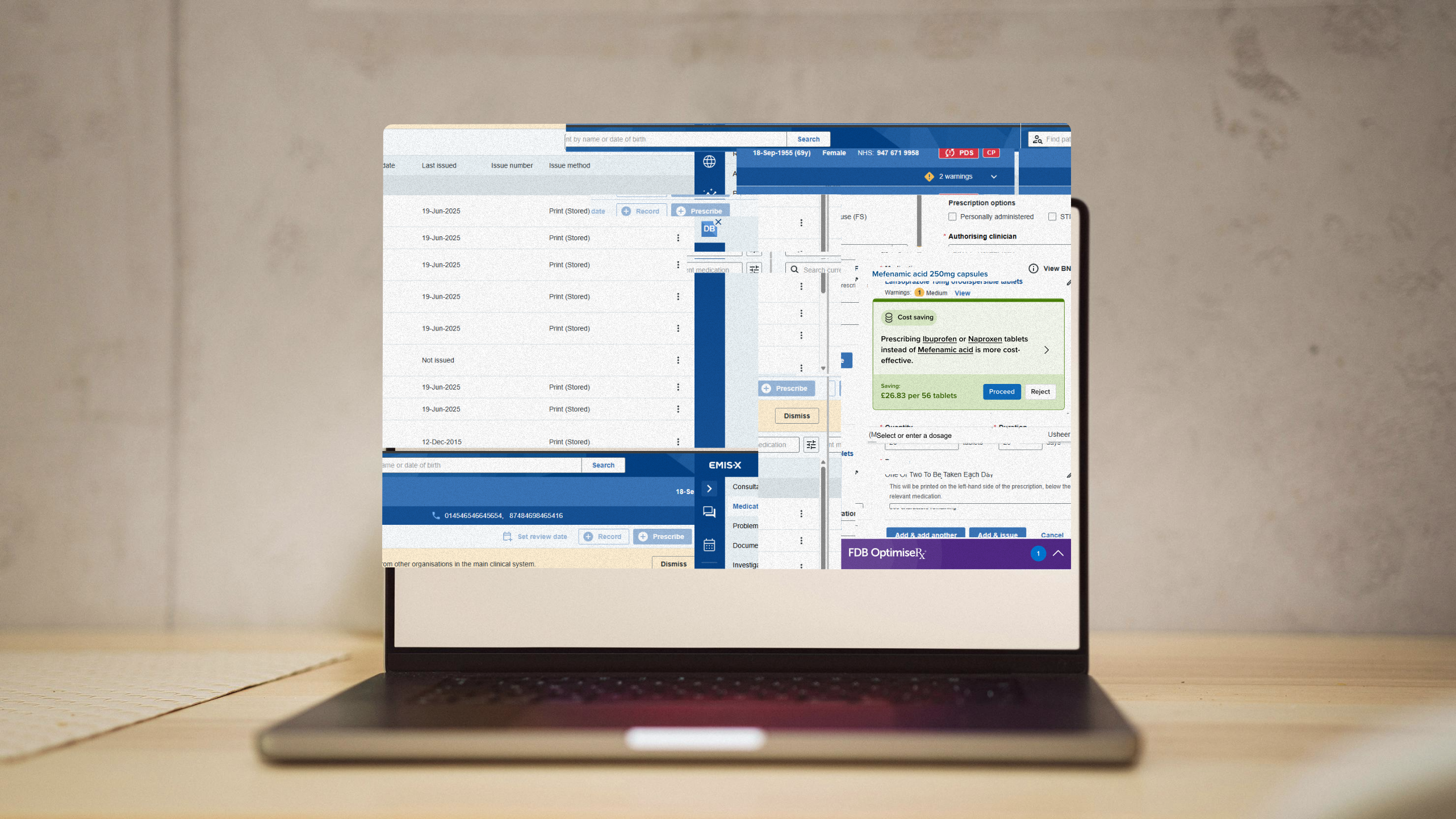
Some products carry a level of consequence that leaves no room for a trust problem to exist at all. First DataBank (FDB) asked us to rethink how prescribing guidance is delivered within OptimiseRx, the clinical decision support software used by GPs across the country. This was not a visual refresh. It was a fundamental reworking of how critical information appears, behaves and supports decision-making in real time – for clinicians working in high-pressure environments where even a small interruption can carry real consequences.
FDB needed the product to surface critical safety information at exactly the right moment, reduce alert fatigue and message overload, and support fast, confident decision-making – all without eroding the confidence clinicians place in the system every time they act on its guidance. We began with one-to-one research sessions with GPs, clinicians and support staff to understand where that confidence was breaking down in the existing experience. We then tested multiple interaction models (modal interruptions, inline messaging and sidebar-based behaviours) against real prescribing scenarios rather than assumptions. Two formal rounds of user testing with GPs and support staff followed, refining the design until it held up under real clinical pressure.
The result is a scalable design system built around a sidebar-first model that supports continuous workflow. A clear, priority-based visual language lets clinicians assess message importance at a glance. And direct actions (accept, reject, modify, order tests) are built in, so messages become decision-support tools rather than passive alerts. Patient safety and clinician confidence were not separate considerations layered on afterwards, they were the brief.
Learn more about our approach in our case study on OptimiseRx.
Studiomade working example: Aviva Pensions
Trust and compliance are not only regulatory problems. For a British multinational insurance, wealth and retirement business, the challenge was that most people simply do not understand what their pension is worth. Aviva wanted to change that, and in doing so, they wanted scheme trustees to be able to purchase Aviva annuities confident that their members would genuinely be supported, not just processed.
We ran three cycles of design, testing and iteration for Aviva’s Defined Benefit pension proposition, through intensive design sprints, agile working and rapid turnaround of user testing reports, to understand what real customers needed and the language that actually resonated with them. Much of that audience is older, often approaching retirement decisions with real anxiety about getting it wrong, which is exactly the kind of user we specialise in supporting. Studiomade is officially rostered with the Design Age Institute, working directly on products and services designed for healthy ageing, so building confidence with an older, more cautious audience was not new territory for us, it was the discipline we brought to the brief. The result had to do two things at once: build genuine confidence in a product people rarely engage with and often do not understand, and position Aviva itself as a supportive company, actively helping members towards a better outcome, rather than simply administering a scheme on their behalf.
As Aviva’s senior stakeholder put it: “Studiomade has a collaborative, engaging way of working and the entire team is positive, expert and outcome focused. Their delivery has made a massive impact in our ability to galvanise senior internal stakeholders and external audiences.”
Read our case study on Aviva Pensions.
Studiomade working example: Dedicate
The same discipline shows up differently again with a more emotional kind of trust. Dedicate, built by Studiomade alongside the University of Oxford to support unpaid carers through an AI-led experience, had to earn belief before it could offer anything else. Dr Caroline Green’s own research found carers were instinctively wary of exactly that format – often exhausted, and understandably sceptical of being handed a chatbot instead of a person. So the product had to earn trust emotionally, through a calm, warm interface and specialist-vetted content rather than the open internet, before compliance and accuracy could even come into play.
Three products, three very different users, the same underlying question: what does this specific person need to see, understand or feel before they trust the product with something that matters to them?
Read the case study of our work with Dedicate.
Why this matters more now than it did two years ago
None of this is a new philosophy for us. What has changed is the cost of getting it wrong, and the reward for getting it right. A regulator actively drafting new rules in public; an FCA authorisation regime that has just gone live; a Treasury comment period with a real deadline on the calendar; an investor market explicitly rewarding proven, evidenced products over promising ones – taken together, these all favour the companies that treat trust and compliance as core to the design brief, not a constraint on it.
Regulation that used to be vague or years away is now specific, live and being written with public input. That is not a reason to treat design as secondary to legal sign-off. It is the clearest argument yet for building the two together from the first sketch – whatever is actually on the line for the person using the product, whether that is a prescribing decision, a pension, or a moment of asking for help.
If you are navigating a new compliance requirement, a trust problem with your users, or both at once, get in touch. We would love to discuss our approach.
Emma Marks
Client Director